
Views: 0 Author: Site Editor Publish Time: 2026-03-18 Origin: Site


Meta Description: Explore the operations of a professional bronze sculpture factory. This comprehensive guide covers lost-wax casting, quality control, patination, and working with manufacturers like Quyang Zhihong Landscape Engineering Co., Ltd. Introduction The creation of a bronze sculpture represents a journey from artistic concept to permanent physical form. Behind every monumental public artwork, commemorative statue, or architectural bronze element lies the specialized environment of a bronze sculpture factory. These facilities combine centuries-old techniques with modern engineering capabilities to transform raw materials into works meant to endure for generations. For architects, landscape designers, municipal planners, and private collectors, understanding how a bronze foundry operates is essential knowledge when commissioning new work. The factory's capabilities directly influence the quality, durability, and artistic fidelity of the final piece. Companies such as Quyang Zhihong Landscape Engineering Co., Ltd. , situated in China's renowned sculpting region, exemplify the integration of traditional craftsmanship with contemporary production methods. This article provides a detailed examination of bronze sculpture factory operations, from material selection through final finishing, offering insight into the processes that define this enduring art form.
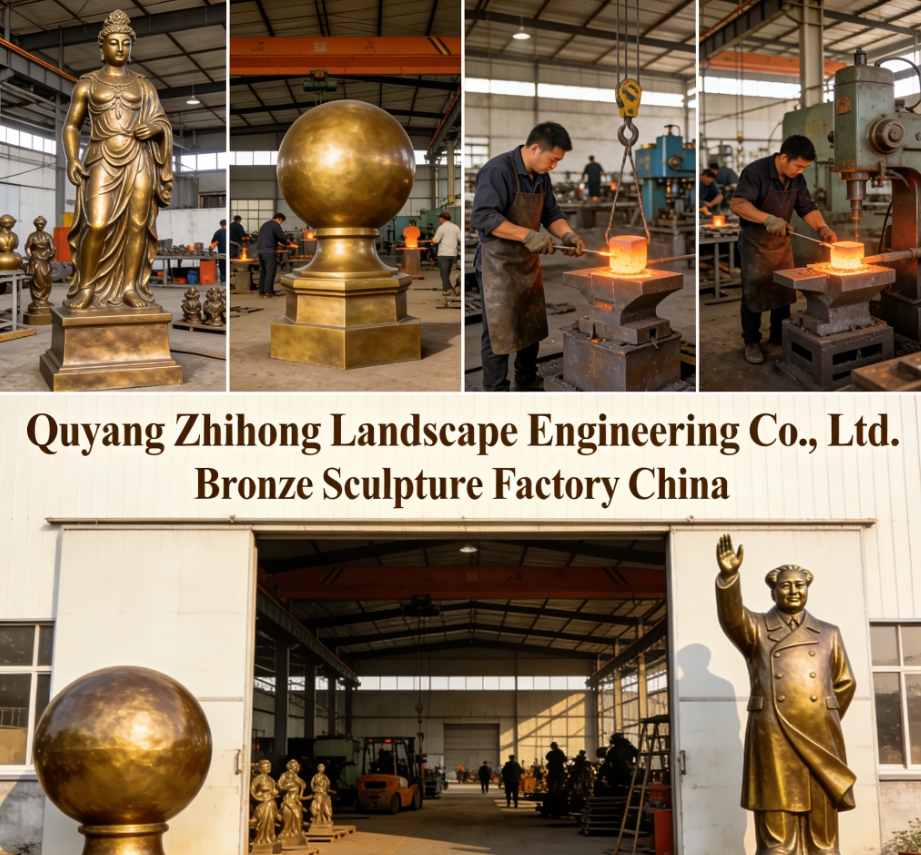
A professional bronze sculpture factory is a specialized industrial facility designed to accommodate the sequential stages of metal casting. Unlike general manufacturing plants, these facilities are organized to support both artistic work and metallurgical processes within the same footprint. The typical bronze foundry contains distinct zones for different operations. The mold-making department requires climate-controlled conditions to ensure rubber and wax materials perform consistently. The slurry room, where ceramic shells are built, must be ventilated to manage dust from refractory materials. The pouring area houses furnaces capable of reaching temperatures exceeding two thousand degrees Fahrenheit, with reinforced floors and overhead cranes for moving heavy ladles of molten metal. The finishing department provides workspace for metal chasing, welding, and patina application. Facility size correlates directly with production capacity. Factories with extensive workspace can accommodate larger projects and maintain dedicated teams for each specialized phase of production. This scale allows for parallel processing of multiple commissions while maintaining quality standards.
The human element remains central to bronze factory operations. A complete production team includes multiple specialized roles, each requiring years of experience to master. Mold makers create the initial rubber impressions from original sculptures. This role demands precision, as any flaw in the mold will propagate through subsequent production stages. Experienced mold makers understand material behavior and can capture fine surface details without distortion. Wax workers, often called wax chasers, receive the molds and produce the wax positives. These artisans refine the wax surface, restoring details that may have been lost during molding and ensuring the surface texture matches the artist's original intent. The quality of wax chasing directly determines the amount of finishing work required after casting. Casters and furnace operators manage the metallurgical aspects of production. They calculate alloy compositions, monitor furnace temperatures, and coordinate pouring sequences to ensure complete mold filling without defects. This role combines scientific knowledge with practical experience. Chasers and finishers work on the raw bronze after casting. They remove gates and sprues, weld sections together, and grind surfaces to achieve the final form. Patina artists apply chemical solutions with torch heat to create the desired coloration, from traditional browns to complex multi-color effects.
Bronze production begins with raw material selection. The quality of the final sculpture depends significantly on the purity and consistency of the metals used in the alloy. Commercial bronze foundries typically maintain relationships with metal suppliers who provide ingots of certified composition. Statuary bronze, the most common alloy for artistic casting, contains approximately ninety percent copper, with the remainder consisting of tin, zinc, and trace elements. This specific ratio produces an alloy with excellent fluidity when molten, allowing it to flow into intricate mold cavities and capture fine surface detail. Some factories maintain in-house testing capabilities to verify alloy composition before casting. Spectrometers can analyze metal samples and provide immediate readouts of elemental percentages, ensuring that each melt matches specifications. This quality control step prevents issues with color inconsistency or mechanical properties in the finished work. Recycled materials also play a role in bronze production. Gates, sprues, and rejected castings are returned to the furnace, reducing waste and material costs. Experienced foundries carefully manage the ratio of recycled to virgin material to maintain consistent alloy properties.
The lost-wax casting method forms the foundation of bronze sculpture production. While the basic process remains consistent with historical techniques, modern factories have refined each stage for efficiency and quality at scale.
The process begins with the original model, which may arrive at the factory as a clay sculpture, a plaster pattern, or a digital file. For traditional clay originals, the factory creates a flexible rubber mold that captures every surface detail. This rubber mold is supported by a rigid plaster or fiberglass mother mold that maintains its shape during wax production. For digital designs, factories may produce patterns directly using computer-controlled carving equipment or three-dimensional printing. This technology allows for precise reproduction of complex geometries that would be difficult to achieve through traditional hand sculpting.
From the molds, workers produce hollow wax replicas by brushing or slushing liquid wax inside the mold cavity. Once cooled and removed, these wax positives receive careful attention from wax chasers who refine surfaces and correct any imperfections. The wax pieces then proceed to assembly, where workers attach a system of wax rods called sprues and gates. This network serves multiple purposes during casting. It provides channels for molten metal to enter the mold cavity, creates pathways for gases to escape, and establishes reservoirs of metal that feed the casting as it cools and shrinks. Proper sprue design requires understanding of fluid dynamics and metal solidification behavior.
The assembled wax tree undergoes investment, where it receives multiple coatings of ceramic slurry. Each layer consists of fine refractory material mixed with a liquid binder, followed by a application of coarse stucco. The piece dips into slurry, drains to remove excess, then rotates under a rain of sand-like material that builds the shell thickness. This sequence repeats until the shell achieves sufficient strength to withstand the thermal and mechanical stresses of casting. A typical shell requires between six and twelve layers, with drying time between each application. The completed shell then rests to allow final curing before burnout.
The ceramic shells enter kilns for the burnout cycle. Temperature increases gradually, causing the wax to melt and flow out through the sprue system. This wax can be collected and recycled for future use. Continued heating drives off residual carbon and sinters the ceramic particles, creating a strong, permeable mold. After burnout, the shells remain hot while foundry workers prepare the metal. Furnaces charge with measured amounts of copper, tin, and other alloying elements, then heat until the mixture reaches the proper temperature. Experienced casters recognize the correct pouring temperature by observing the metal's fluidity and surface characteristics. Pouring requires coordination between multiple team members. A crane lifts the crucible from the furnace and positions it over the mold tree. Workers guide the pour, ensuring a steady stream that fills all cavities without turbulence that could trap gases or erode the ceramic.
After cooling, workers remove the ceramic shell using vibration, water jets, or mechanical tools. The bronze tree emerges, showing the sculpture pieces connected by the metal sprues. Workers cut these connections, separating the individual components and sending the sprue metal back to the scrap pile for recycling. Each bronze piece now requires metal chasing. Welders assemble multi-part sculptures, joining sections with bronze filler rod. Grinders and finishers smooth the weld seams and remove any surface irregularities from the casting process. This work returns the surface to the refined condition of the original wax pattern.
Raw bronze emerges from casting with a bright, golden appearance similar to new penny coins. For most sculptural applications, this surface requires transformation through patination to achieve the desired final color. Patina application combines chemistry with artistic judgment. The bronze surface must be absolutely clean, free from oils or residues that would prevent uniform chemical reaction. Workers heat the metal with torches, then brush or spray chemical solutions onto specific areas. The heat accelerates reactions between the metal and chemicals, producing color changes that range from light browns through deep chocolates to blacks, greens, and blues. Different chemicals produce characteristic colors. Sulfur compounds create brown and black tones. Nitrates and chlorides generate greens and blues. Ammonia compounds can produce blue-green patinas. Skilled patina artists mix solutions and control heat application to achieve subtle color variations and graduated effects. After achieving the desired coloration, the factory applies a protective wax coating. This wax seals the patina, preventing further chemical change while deepening and enriching the color appearance. The wax layer requires periodic renewal during the sculpture's life, but the underlying patina remains stable beneath this protection.
Large bronze sculptures present engineering challenges beyond those of smaller works. Factories that produce monumental pieces must integrate structural engineering into their manufacturing process. Wall thickness requires careful specification. Bronze sections that are too thin may lack strength or prove difficult to cast completely. Sections that are too thick add unnecessary weight and cost. Experienced foundries typically maintain wall thickness between five and eight millimeters for large sculptures, balancing strength against material economy. Internal armatures provide additional support. Stainless steel frameworks welded inside the hollow bronze shell distribute loads and transfer weight to the base. These armatures must accommodate thermal expansion differences between steel and bronze while providing adequate support for the sculpture's weight and external forces such as wind loading. Section size limits arise from practical considerations. Very large sculptures must divide into multiple pieces that can be cast, transported, and assembled on site. The factory determines section boundaries based on furnace capacity, crane lifting limits, and shipping constraints. Each section requires precise fitting so that final assembly produces seamless transitions. Base design and anchoring demand attention to site conditions. The factory engineers mounting systems appropriate for the installation environment, whether interior gallery floors or outdoor plaza settings subject to freeze-thaw cycles and seismic activity.
Quality management in bronze production involves inspection at multiple stages rather than final inspection alone. Each department verifies its work before passing materials to the next stage. Mold makers inspect their rubber impressions against the original model, checking for captured detail and dimensional accuracy. Wax chasers examine every surface under appropriate lighting, correcting imperfections before investing. After casting, metal chasers verify wall thickness and check for hidden defects such as porosity or incomplete filling. For critical applications, factories may employ non-destructive testing methods. Ultrasonic thickness gauges verify uniform wall thickness. Dye penetrant inspection reveals surface cracks invisible to casual observation. Radiographic examination can detect internal voids in structural welds or critical sections. Documentation accompanies each project through production. Photographs record key stages, providing reference for later work and documentation for clients. This paper trail proves valuable for future restoration or replication work.
Bronze sculpture production follows predictable timelines based on project complexity and scale. Factories provide estimated schedules that account for each production phase. Simple sculptures may move through production in several months from mold making through final finishing. Complex monumental works with extensive detail and large scale can require twelve months or more from initial consultation to installation. The factory coordinates with clients throughout production, providing progress updates and resolving questions as they arise. This communication ensures that the final sculpture meets expectations and that any design adjustments occur early when they are easiest to implement.
Bronze factories serve diverse markets with varying requirements. Understanding these applications helps clients select manufacturers with appropriate experience. Public art commissions typically require monumental scale, structural engineering, and coordination with installation contractors. These projects demand factories with large facility capacity and experience managing complex logistics. Architectural applications include custom doors, railings, hardware, and decorative elements. These pieces often require integration with building systems and coordination with construction schedules. Factories serving this market maintain capabilities for precise dimensional control and finish matching. Private commissions range from life-sized portraits to small tabletop sculptures. These projects benefit from factories that maintain close artist collaboration and offer flexibility in finish development. Memorial and commemorative work requires sensitivity to subject matter and durability for permanent installation. Factories producing grave markers, plaques, and memorial statues understand the importance of legible inscription and permanent finishes.
Quyang Zhihong Landscape Engineering Co., Ltd. operates from a region with deep roots in sculptural tradition. The company combines this heritage with modern manufacturing capabilities suited to contemporary project requirements. The company's portfolio spans public monuments, architectural bronze work, and custom commissions for clients worldwide. Their facility accommodates projects of various scales, from intimate gallery pieces to large-scale landscape installations. The team includes specialists in each phase of bronze production, ensuring consistent quality from pattern through patina. Client engagement begins with project consultation to understand artistic intent, site conditions, and budget parameters. This information guides material selection, production approach, and timeline development. Throughout fabrication, the company maintains communication with clients, providing updates and seeking input at key decision points. For architects and designers seeking a manufacturing partner, the company offers technical expertise in structural requirements and installation coordination. For artists, they provide collaborative support in translating original models into permanent bronze. For private clients, they deliver finished works that meet expectations for quality and artistic fidelity.
Bronze sculpture factories represent a unique intersection of art and industry, where traditional craftsmanship meets modern engineering. Understanding factory operations helps clients make informed decisions when commissioning bronze work, from material selection through finish specification. The production process follows established sequences, each requiring specialized skills and careful quality control. From initial mold making through final patina application, every step contributes to the lasting quality of the finished sculpture. For those considering bronze commissions, partnering with an experienced manufacturer such as Quyang Zhihong Landscape Engineering Co., Ltd. provides access to comprehensive capabilities and technical expertise. With proper planning and collaboration, the factory transforms artistic concepts into permanent bronze forms designed to endure for generations in their intended environments.


